
Breaking News
JUST-IN: Fujairah Is On Fire. Not Because A Drone Hit The Port. Because a Drone Was Shot Down Above It

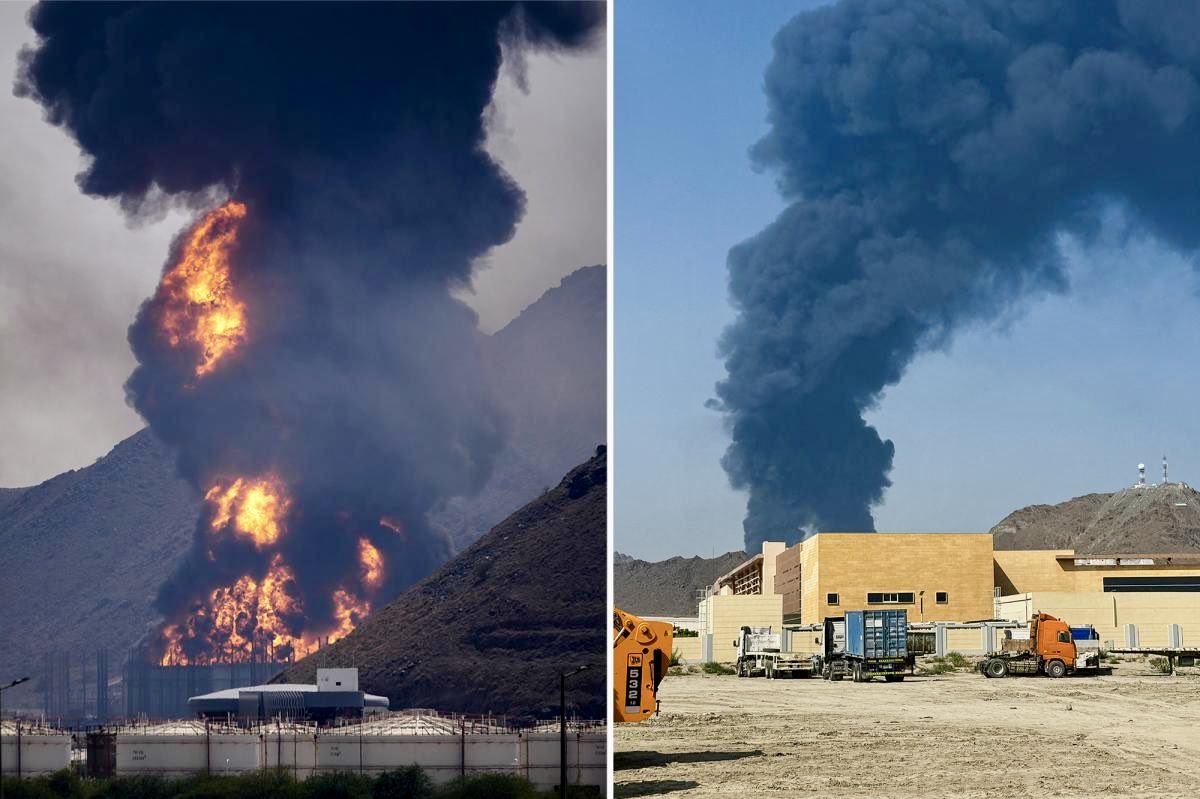
Bloomberg and Reuters confirmed a fire erupted at the Fujairah Oil Industry Zone on 14 March after debris from an intercepted Iranian drone fell onto port infrastructure. Oil loading operations were partially suspended. This is not the first time.
A similar debris fire struck Fujairah on 3 March. The pattern is now structural: Iran launches, the UAE intercepts, the wreckage falls on the infrastructure the interception was supposed to protect, and the fire department arrives to manage what the missile defence system produced.
The interception rate is 94%. The fire rate is not zero.
This is the mathematics the defence briefings do not address. Two hundred ninety-four ballistic missiles, 15 cruise missiles, and 1,600 drones have been fired at the UAE since 28 February. The vast majority are intercepted. Six people are dead. One hundred forty-one are injured. But interception does not mean disappearance. A Shahed drone shot down at altitude becomes debris falling at terminal velocity onto whatever sits below the interception point. When the interception point is above a port that handles 40% of the world’s bunkering fuel, the debris becomes a fire at the bunkering hub.
Brent crude surged to $96.72, up 8.9% on the day. WTI reached $91.83, up 8.4%. The Fujairah fire, combined with the Kharg Island raid, the Hormuz traffic collapse, and Iran’s explicit threat to strike all US-linked sites in the UAE, has driven oil to its highest sustained level since the war began.
The IEA’s 400 million barrel coordinated reserve release, the largest in history, is being consumed by a market that watches a port burn and calculates how many more interceptions produce how many more fires.
Hormuz traffic is down 70 to 97% from pre-war levels. Rerouting around Africa adds 10 to 14 days and increases freight costs 20 to 30%. The seven P&I clubs that cancelled war-risk coverage have not reinstated.
The $20 billion DFC insurance has no confirmed takers. And now the bunkering capital of the Gulf is partially suspending loading operations because the defence system that protects it is raining wreckage onto it.
Fujairah is not Hormuz. It sits on the Gulf of Oman, outside the Strait, specifically chosen decades ago as an alternative export and bunkering hub precisely because it was supposed to be beyond the reach of Hormuz disruptions. The war has erased that geography. Iranian drones do not respect the distinction between the Strait and the coast beyond it. The interception debris does not respect the distinction between military airspace and commercial port space. The fire at Fujairah is the proof that no port in the Gulf is beyond the war’s reach, even the ones the missiles do not hit.
Iran’s Khatam al-Anbiya headquarters has declared all US-linked facilities in the UAE legitimate targets. The evacuation call for port workers issued hours before the Fujairah fire was not coincidence. It was pretext. The IRGC cannot reliably strike Fujairah directly with its degraded arsenal. But it does not need to. It needs only to launch enough drones to ensure that the interceptions produce debris, the debris produces fires, and the fires produce the footage that makes every tanker captain, every insurance underwriter, and every port operator calculate whether the 94% interception rate is high enough to risk a billion-dollar vessel beneath it.
The defence system works. The debris it produces also works. And the port is burning from the success of the system that was built to prevent it from burning.
-

 Breaking News10 months ago
BREAKING NEWS: Labour Congress Call For Review Of Minimum Wage, Propose N150,000 Pay For Lagos Workers
-

 Breaking News10 months ago
ALLEGED BLASPHEMY: Angry Youths Kill Female Food Seller In Niger State
-

 Entertainment10 months ago
Burna Boy Used To Squat In My House – Cubana Chief Priest
-

 Entertainment10 months ago
Popular Nigerian Comedian, Josh2Funny And Wife, Bina, Welcome Third Son
-

 Entertainment10 months ago
BBNaija S10: I Was Prevented From Returning To Show Despite Being Medically Fit – Sabrina
-
 Entertainment10 months ago
[VIDEO] Ibom Air Incident: Comfort Emmanson Opens Up on Traumatic Experience
-

 Entertainment10 months ago
Media Personality Toke Makinwa Make Confession On Fearful Pregnancy Journey, Shares Fresh Maternity Shoot
-

 Breaking News10 months ago
BREAKING: CAC Extends New Fee Regime To October 1
-
 Breaking News10 months ago
BREAKING: 1 Israeli Soldier Dead, 9 Injured, 4 Missing
-

 Politics10 months ago
Soludo Mocks Obi, Declares ADC and LP “Dead” After Anambra By-elections
-
 Breaking News10 months ago
Bukuyum: Air Operations Force Bandits To Release 70 Kidnapped Victims In Zamfara
-
 Breaking News10 months ago
BREAKING: Hamas Captures Israeli Soldiers in Gaza